
AI SEO content that doesn’t read like AI: process, checks and human review
 Francesc Sánchez
— CEO and AI Consultant
Francesc Sánchez
— CEO and AI Consultant

A long draft comes out of Claude or ChatGPT in less time than it takes to read it. That has moved the bottleneck of a company blog: it used to be writing, and now it’s deciding what gets published. Many SMEs have learned this the hard way, publishing article after article that all sound the same, with a couple of figures nobody can trace and not a single detail that only that company could have written.
Creating SEO content with AI works, and Google doesn’t forbid it. What you need is to set up the work as a process with separate pieces, where the machine does what it does well, another machine checks what can be checked automatically and a person reviews what only they know. This guide explains how to set up that split, which checks can be automated and how much human time each article still needs.
What AI speeds up and what has to come from someone who knows the business
Think of an article on how to choose invoicing software. To write it you need to know what people are searching for and what the articles that already rank say, then organize the ideas, draft, review and publish. AI speeds up almost all of that a great deal, especially the volume work: reading competitors’ articles and pulling out their sections, proposing a structure, writing a clean first draft, generating title and meta description variants.
There’s another part it doesn’t speed up at all, because it isn’t anywhere the model can read. Which software you genuinely recommend to your clients and why, how long implementation takes in your experience, which mistakes you see every week. A language model writes fluently about any topic, and that’s exactly why it writes the same as everyone else unless you give it your own material. The text comes out correct and generic, and generic is what Google and readers already have plenty of.
Between the two extremes there’s a whole range. Some people generate everything automatically and publish without looking, some use AI as an assistant for a text a person writes, and there’s a middle ground where AI drafts and a person reviews with judgment. For an SME that wants to win clients through its blog, we go for the middle ground, and it’s the split we set up at La Teva IA when we automate a company’s content. The rest of this guide is about how to set it up without the review eating up the savings.
How an SEO article is generated with AI, from search to draft
It all starts before you open the chat. First you choose the keyword with demand data behind it, checking in Ahrefs, Semrush or Search Console itself which searches have volume and fit what you sell. A keyword nobody searches for gives you an article nobody will find, however well written it is.
Next comes looking at what ranks today for that search. You open the top Google results, or ask an automated workflow to download them, and note which sections keep coming up. That list tells you what searchers expect to find, and also what all of them are missing, which is usually where your article can add something.

First the heading structure, then the paragraphs
If you ask a model to “write me an article about X”, it decides the structure on the fly, and it decides it based on the average of everything it has read. You get the usual introduction, the predictable sections and a conclusion that sums up what came before.
It works better to separate the two things. In a first call the AI proposes a broad list of headings based on what it found in the competition, and a person, or a criterion written in advance, prunes that list down to the ones that genuinely answer the search and the ones that bring an angle of your own. A useful limit is words per heading, because with too many sections for the article’s length each one ends up as a paragraph of filler.
The approved structure is saved as a separate document. That way the next step works from a closed list, and if the draft comes out wrong you know whether the problem was in the structure or in the writing.
The draft section by section, not all at once
Asking for the whole article in a single call has a cost you don’t see until the end, because the model spreads its attention and the last sections come out thinner and more repetitive than the first ones. Writing in blocks, or at least giving it the closed structure and a set of specific style rules, gives a more even result.
Those rules are worth more the more specific they are. “Write naturally” changes nothing, whereas a list of banned expressions, a cap on adjectives per noun or an instruction not to close with a summary paragraph do change the text. If you have older articles written by someone on your team, giving them to the model as a voice sample helps the rhythm sound like yours. It’s also a good idea for each call to start clean, without dragging along the previous conversation. A model that has seen how the structure was reasoned tends to justify it in the text instead of writing for the reader.
What a script checks before anyone reads it: figures, links and filler phrases
The draft is done and a person still doesn’t need to read it. There’s a list of checks a script runs in seconds, and running them first saves the reviewer from spending their time on mechanical errors.
Figures are the first filter. A script can flag every number, every percentage and every price in the text and check whether it has a link or a source next to it. It can’t tell whether the figure is true, that’s the person’s job, but it does leave a list of what needs checking, and that list is what stops a made-up percentage from getting published. Models generate figures with great confidence, and the ones that sound most like a study are often the ones that don’t come from any.
Links are the second. A tool like Screaming Frog, or an n8n workflow that sends a request to every URL in the text, detects links that return errors. With AI this matters more than usual, because a model can write a real-looking address that doesn’t exist.
The third is filler phrases. Some expressions and constructions give away a generated text: grandiose openings about today’s world, brochure-style imperatives, endings that sum up what’s already been said, the contrast sentence that denies one thing to assert another, overuse of dashes and colons. A list of those expressions can be searched for automatically, just as you can measure whether all the sections are the same length, which is another clear sign of a template.
What a person reviews before publishing, and why it can’t be skipped
Google says so in its documentation for publishers using generative AI content. It asks you to check by hand and review all generated content before publishing it, because models can make mistakes, and it extends that review to titles, meta descriptions, structured data and image alt text. On the same page it warns that generating many pages without adding value for users may violate its scaled content abuse policy.
The practical reason goes beyond Google. An article with a false fact about your industry, or with a promise your company doesn’t keep, costs more than not publishing it at all.
Every figure, date or claim that could change the reader’s decision
This is where the list left by the automated check comes in. Every tool price is checked on the vendor’s website, and every date and every claim about a law or regulation is looked up in the original source, not on another blog that repeats it.
Not all data carries the same weight. If the article says a tool has a free plan and the reader is going to decide based on that, it has to be checked. If the figure can’t be found, the honest way out is to write the sentence without the number, or remove it.
What only your company knows: timelines, cases and ways of working
This is the part that stops the article from sounding like it could be anyone’s. The reviewer looks for the gaps where the draft speaks in general terms and fills them with what the company knows: in what order you do things with a client, what timelines you give, what you recommend avoiding, what question you always get asked in the first meeting.
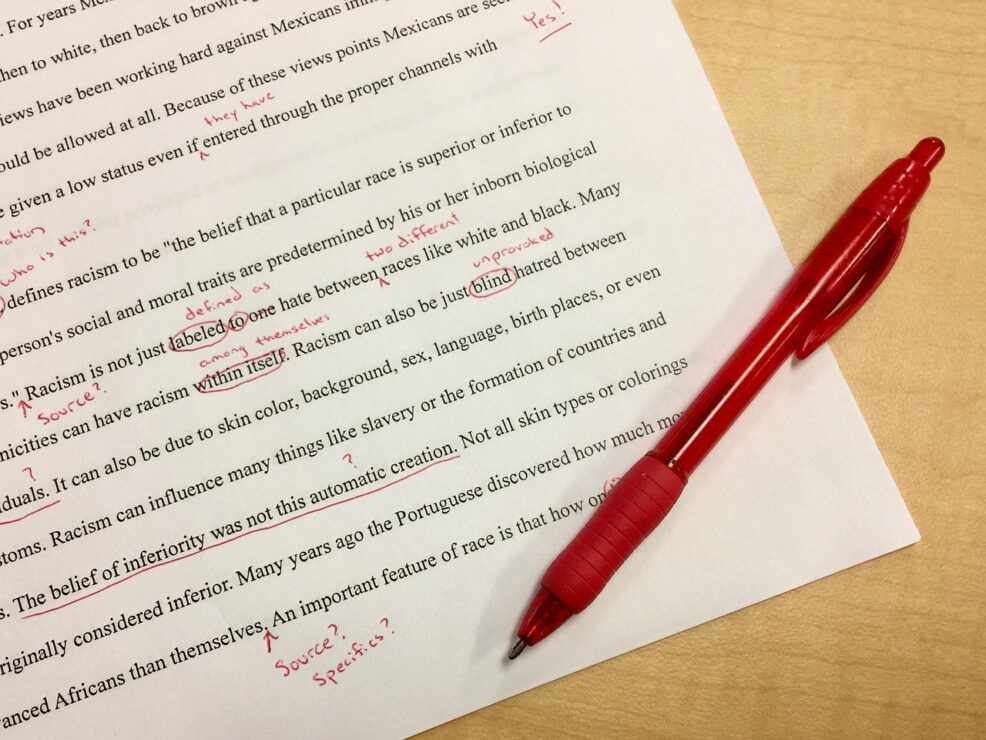
It’s also the part AI can’t make up without doing damage. Ask a model for an example and it will write you a plausible case with a name and results, and publishing it as your own is lying. If you don’t have a case to tell, a procedure described in detail is more convincing than a fabricated success story.
Whoever does this review has to know the business, even if they know nothing about SEO. It’s often the owner, or whoever deals with clients, and in practice it means a while spent reading with a pen in hand, marking where the text says something you wouldn’t say.
The brand’s tone and the phrases that give AI away
The final read is out loud, or nearly. Automated filters catch the expressions on a list, but they don’t catch a paragraph that sounds like a brochure, a run of sentences with the same rhythm, or a way of addressing the reader that isn’t yours.
It helps to have in writing how the brand speaks: whether you address readers formally or informally, which words you avoid, how much you explain before getting to the point. With that sheet in front of them the reviewer corrects with judgment rather than taste, and the same sheet then works as an instruction for the model, so each review round improves the next draft.
How much time and money each AI-written article costs
The question an SME owner asks is whether this works out cheaper than outsourcing the articles. It depends on how much of the process is set up.
With a chat and nothing else, no prior structure and no checks, the savings are smaller than they seem. The person ends up rewriting half the text, tracking down where each figure came from and fixing the tone by hand, and that can easily add up to several hours per article, although it’s a rough estimate that varies a lot by topic. The set-up process has three pieces: research and structure in a workflow, a section-by-section draft with fixed rules, and automated checks before review. With those pieces running, human time comes down to the review and deciding which topics get written, which for a long article is in the region of an hour or two.
The money is the small part. A Claude Pro subscription costs $20 a month on monthly billing, according to Anthropic’s pricing page, and if the workflow calls the model via API the cost depends on how many words it processes, but for a blog with a few articles a week it usually stays below what the SEO tool costs. Ahrefs’ Lite plan, for example, comes to €119 a month according to its pricing page, and there’s a cheaper Starter plan with fewer features. Building the workflow in n8n does have an upfront cost, in hours from someone who knows how, and it pays off when the blog is going to publish consistently for months.
When we look with a company at whether automating its content is worth it, we start from these paths:
- Doing it in-house with a chat and a good rules sheet, which works for a blog that doesn’t publish much.
- Outsourcing it, which makes sense if nobody in the company can spare even that hour of review.
- Building an automated workflow with human review, which pays off when content is a real lead generation channel and the volume justifies the upfront investment. It’s the one we build with n8n at La Teva IA.
If you want to see which part of your content production can be automated and which is best kept in your team’s hands, tell us how you do it now.
About the author
Francesc Sánchez — CEO and AI Consultant
I'm the founder and CEO of La Teva Web, latevaIA and Semseo Agency, and a consultant specializing in artificial intelligence, automation, GEO and vibe coding. With more than 24 years of experience in digital strategy and transformation, I help companies apply AI to optimize processes, improve their productivity and create new business opportunities. I'm also an expert advisor in digital transformation and AI accredited by ACCIÓ.
Articles by Francesc